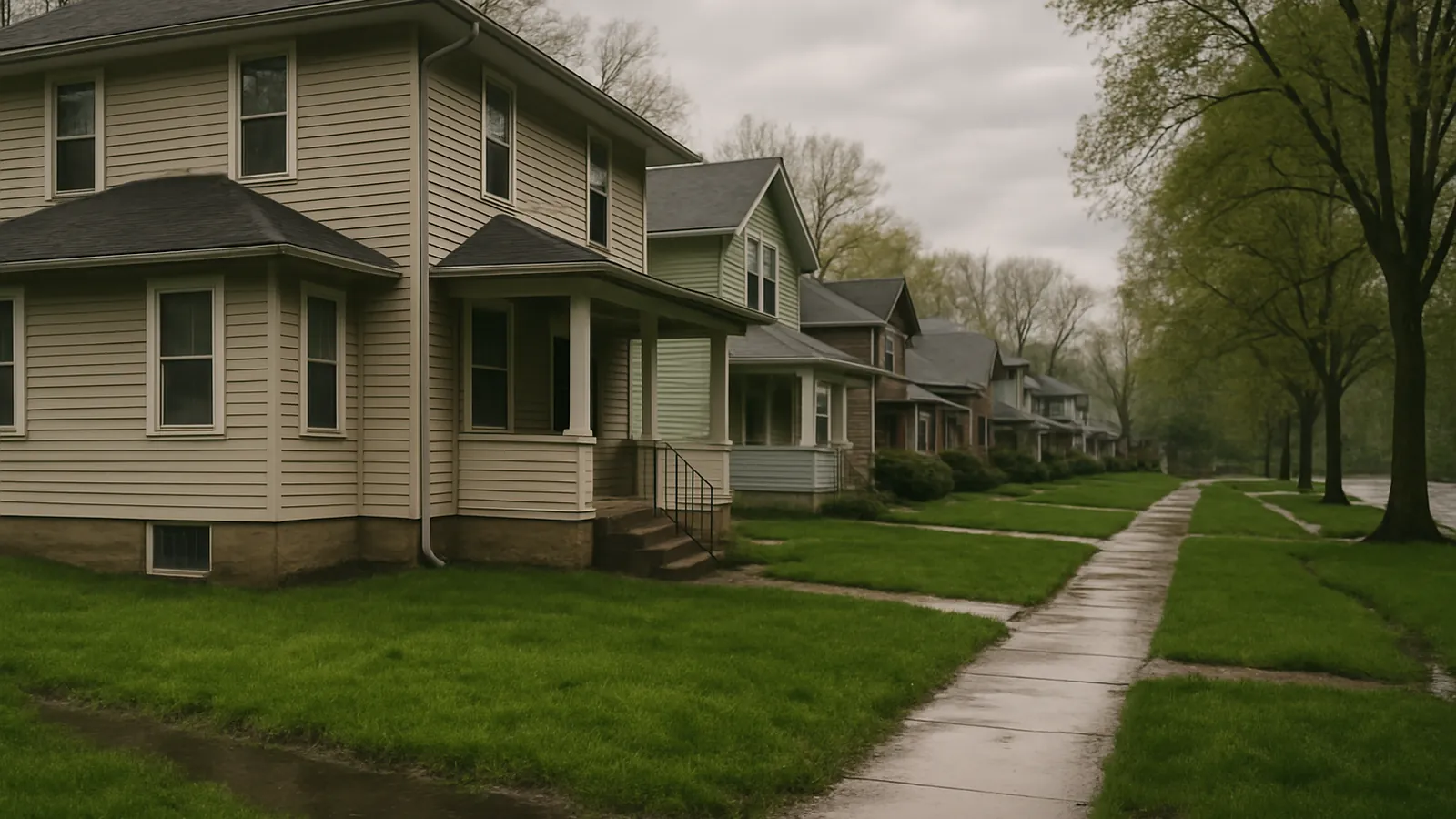
Helical and push piers for Fort Wayne foundation repair both run $1,200–$3,000 per pier; the choice follows structure weight. Push piers drive to logged refusal under heavier masonry; helicals torque to measured capacity — the fit for light frame, additions, and the stoops frost heaves every winter.
How each proves capacity, and what saturated till does to depth and scope.
Two proofs of the same promise
A pier in Allen County carries the footing through chronically wet upper till — soil that saturation has softened and frost churns yearly — to bearing that holds in every season. A push pier is hydraulic steel driven beside the footing using the structure as reaction weight until it refuses to advance; the logged refusal is its proof. A helical pier screws in on welded plates, installation torque correlating with capacity — proven by the gauge as it turns, no house weight required.
Side by side
| Push piers | Helical piers | |
|---|---|---|
| Advance | Driven against the structure’s weight | Rotated to specified torque |
| Proof | Refusal pressure, logged per pier | Installation torque, logged per pier |
| Needs house weight | Yes | No |
| Fort Wayne fit | Older two-story brick, heavier masonry | Ranches, additions, frost-heaved stoops and porches |
| New construction | No | Yes — proven before framing |
| Cost | $1,200–$3,000 per pier; wet-till depth sets the spread | |
What the saturation story does to the decision
Two Fort Wayne specifics shape every pier scope. First, depth: proof is only accepted below the saturated zone, and on wet till that honest depth can run deeper than dry-clay markets expect — more sections, priced in the written scope rather than discovered on invoice day. Second, the water itself: piers stabilize the footing while the till around them stays wet, so scopes here pair steel with water management as a rule — and with wall restraint where the same saturation pushes laterally. Whether piers are the right repair at all is the settlement diagnosis; install mechanics live on the piering page.
Lifting older masonry without new cracks
Recovery on brittle brick happens in small synchronized increments against live crack monitoring — or not at all, where the wall argues against it and stabilization is the honest scope, stated in writing before steel goes in. Cracked joints get injection and stitching after movement stops. The arithmetic behind counts and depths is in the cost guide.
What the pier warranty is actually worth
Read the warranty before the price. It covers the piers’ capacity — the supported section carrying its design load — not the whole house and not the parts nobody piered. Four questions separate a real warranty from a brochure: is it transferable, does the transfer cost a fee, does it cover the piered section or the structure, and does it survive the contractor closing its doors (third-party-backed warranties do). In a saturated market, ask a fifth: whether the warranty is conditioned on drainage or sump maintenance you are responsible for. That clause is fair and it is enforced. Keep the torque or depth log with the paperwork — on till this dense, refusal depth is the story of the job, and a warranty with no log has nothing behind it.
Pier questions, straight answers
Do the two pier types cost differently in Fort Wayne?
No — both run $1,200 to $3,000 per pier, with depth to bearing and access setting the spread. Wet till can mean more sections before honest bearing answers, which moves cost more than pier type ever does. The real choice is which proof your house can deliver: refusal needs structure weight, torque doesn't.
Which type fits the older basement stock?
Push piers where the mass exists. Two-story brick near the rivers and in the older neighborhoods carries reaction weight enough to drive steel to convincing, logged refusal. The same houses demand staged lifting — brittle masonry over a full basement punishes enthusiasm — which is a labor consideration, not a pier-type one.
Which type fits ranches and additions?
Helical, usually. Single-story frame is light — a push pier can run out of house weight before refusal convinces on stiff till — and helicals prove capacity by torque regardless of the structure. They're also the standard answer under the frost-heaved stoops and porches this climate manufactures every winter.
Does the high water table complicate pier work?
It defines it. Wet till is exactly what piers exist to get through — proof is only accepted at depths below the soft, saturated zone, and the per-pier log records where that honest depth turned out to be. What water really changes is scope: steel without drainage leaves the saturation cycling around it, so Fort Wayne pier bids should mention the water.
What documentation should any pier bid include?
Per-pier proof logging (torque or refusal), the depth assumption with pricing beyond it, and which structures justify the chosen type at each location — plus, in this county, what the scope does about the water. Honest bids converge once those are in writing. Ours arrive with the logs promised and a transferable warranty attached.
How long does the install take, and do we have to move out?
Most residential pier jobs run two to five days depending on pier count and access, and nearly everyone stays in the house. Expect equipment in the yard, excavation at the footings, and noise during working hours. Interior disruption is usually limited unless the scope includes a basement wall. The yard takes the visible hit, and restoration should be written into the scope.
Get a free Fort Wayne foundation evaluation
Tell us what the basement is doing — water at the cove joint, a wall bowing inward, a horizontal crack in block, floors going out of level — and we’ll schedule an evaluation with photos, wall measurements, and floor elevations. We reply the same business day.